
Synthetic Data for Testing, Analytics & AI
Paxcel’s Synthetic Data Generation solution creates artificial datasets that are statistically equivalent to real-world data, enabling organizations to support testing, analytics, and model training while reducing exposure to sensitive information.
What Is Synthetic Data?
Synthetic data is artificially generated information designed to reproduce important statistical characteristics and patterns of real-world datasets.
Instead of exposing sensitive production data, organizations can use synthetic datasets for selected development, testing, analytics, and AI/ML scenarios.
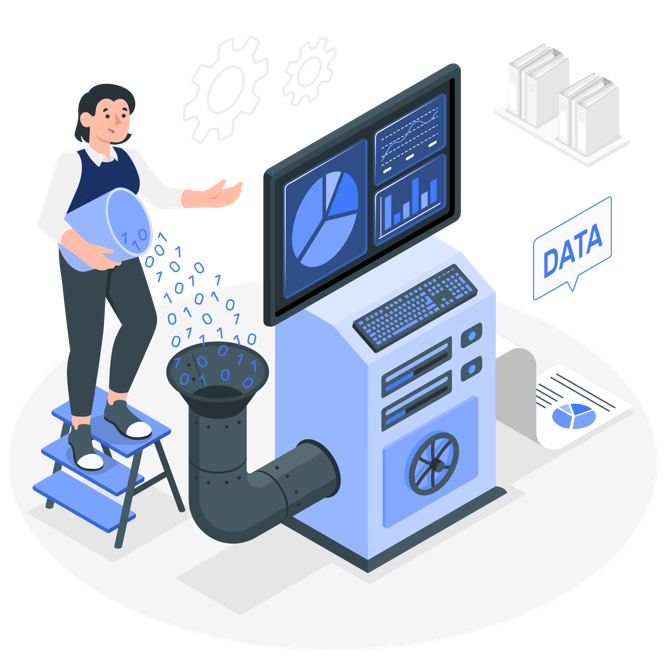
Key Benefits of Synthetic Data Generation
Expand data availability, reduce exposure to sensitive records and accelerate testing, analytics and AI development.
Protect Sensitive Information
Reduce the need to expose sensitive financial, personal, or customer information during development and testing.
Accelerate AI & ML Development
Create rich datasets that can support AI and machine learning model development.
Enable Safer Testing
Use realistic synthetic datasets for testing applications, workflows, and data pipelines.
Reduce Data Acquisition Costs
Reduce dependence on acquiring large volumes of real-world data for selected use cases.
Support Data Privacy
Synthetic datasets can help organizations reduce exposure of sensitive information while supporting data-driven initiatives.
Create Diverse Datasets
Generate datasets that can help teams overcome data scarcity and support broader testing and model development scenarios.
Why Organizations Need Synthetic Data
Overcome data access restrictions, privacy concerns and limited datasets to keep development and experimentation moving.
Sensitive data limits access
Personal and confidential records can restrict who can use production datasets and for what purpose.
Privacy & accessSharing creates friction
Teams and partners need useful data to collaborate, while real records require careful sharing controls.
Team collaborationNew records.
Useful patterns.
More possibilities.
Synthetic data offers an alternative to using real records directly, with artificial datasets designed to reflect relevant data characteristics.
| Sample ID | Age | Transactions |
|---|---|---|
| SYN-001 | 34 | 12 |
| SYN-002 | 48 | 8 |
| SYN-003 | 29 | 16 |
Fictional example. Evaluate generated data for usefulness and privacy before use or sharing.
Testing needs realistic inputs
Small, repetitive test datasets can miss important scenarios and make system behavior harder to assess.
Development & QAUseful datasets are hard to source
Data scarcity and acquisition costs can slow experimentation, analytics and AI development.
Data availabilityHow Synthetic Data Generation Works
Understand your source data, generate synthetic records and validate them for testing, analytics and AI.
-
01
Understand the source
Identify relevant fields, relationships and statistical characteristics in the source dataset.
Understand the structureAge Region TransactionsFields · Patterns · Relationships -
02
Generate new records
Create artificial records designed to reflect the characteristics needed for your use case.
Illustrative generated rowsSYN-001SYN-002SYN-003 -
03
Evaluate the dataset
Assess quality, usefulness and privacy risks against the intended application.
Evaluation areas- Structure and consistency
- Relevant statistical patterns
- Privacy and disclosure risks
-
04
Use and experiment
Use the evaluated dataset in appropriate development and analysis workflows.
Potential applicationsTesting Analytics AI / ML Experiments
Illustrative workflow. Evaluation may lead to adjustments and regeneration before the dataset is ready for use.
Synthetic Data for AI & Machine Learning
Generate realistic datasets to support model training, evaluation and experimentation when real-world data is limited.
Move experiments forward when data is limited.
AI projects need relevant, high-quality examples. Access restrictions and gaps in available datasets can make those examples difficult to obtain.
- Explore scenarios missing from available data.
- Supplement datasets for training experiments.
- Assess model behavior with controlled test inputs.
Conceptual illustration; sample counts do not indicate performance or data quality.
Check relevant patterns, model utility and privacy risks.
Paxcel helps create synthetic datasets designed to reflect relevant statistical characteristics for AI/ML training and experimentation.
Synthetic Data for Financial Services
Financial organizations manage highly sensitive customer and transaction data.
Explore financial scenarios with synthetic data.
Customer and transaction records are sensitive. Synthetic datasets offer artificial examples for development, testing and experimentation.
| Record | Amount | Scenario |
|---|---|---|
| SYN-001 | ₹1,250 | Routine purchase |
| SYN-002 | ₹85,000 | High-value test |
| SYN-003 | ₹499 | Recurring payment |
Fictional examples. A high-value transaction alone does not indicate fraud.
-
01
Fraud detection development
Explore transaction scenarios and assess how detection models respond to different patterns.
-
02
AI/ML testing
Test model pipelines and compare behavior across controlled synthetic inputs.
-
03
Analytics exploration
Prototype dashboards, queries and reporting workflows using artificial records.
-
04
Marketing experimentation
Explore segmentation and personalization approaches before validating with appropriate data.
-
05
Application testing
Exercise transaction flows, input variations and edge cases in development environments.
Built around your intended use. Evaluate synthetic datasets for relevant patterns, usefulness and privacy before applying them to financial workflows.
Synthetic Data for Software Testing
Create realistic test scenarios and edge cases while reducing reliance on sensitive production data.
Customer records need protection.
Unrestricted access to real customer data can expose personal and confidential information.
Symbolic preview; no customer information is shown.
Build scenarios worth testing.
Create artificial records for routine flows, input variations and deliberately designed edge cases.
Fictional scenarios configured for the application under test.
Evaluate generated data for test coverage, usefulness and privacy before use.
Synthetic Data for Analytics
Explore patterns, build analytical workflows and test data pipelines without relying directly on sensitive production records.
Explore patterns
Experiment with distributions, groupings and relationships represented in the generated dataset.
Build analytical workflows
Develop queries, aggregation logic and dashboard layouts using artificial sample records.
Test data pipelines
Exercise ingestion and transformation steps with controlled inputs and intentionally varied records.
Synthetic Data & Data Privacy
Synthetic data should be considered as part of a broader data privacy and governance strategy.
Paxcel’s overall platform emphasizes data sovereignty, encryption, access controls, governance, and secure processing.
Keep control at the center.
Synthetic data belongs within a broader privacy and governance strategy. Paxcel emphasizes control over the environment where data is processed.
-
Encryption
Protect sensitive information with encryption as part of the platform’s security controls.
-
Access controls
Manage who can access datasets and participate in data-processing workflows.
-
Governance
Define appropriate uses, responsibilities and review requirements across the data lifecycle.
-
Secure processing
Apply security controls to the workflows used to prepare and generate datasets.
Privacy needs evaluation. Synthetic data is not automatically anonymous. Assess disclosure risks and suitability before use or sharing.
FAQs
What is synthetic data generation?
Synthetic data generation creates artificial datasets designed to reproduce important characteristics of real-world data.
Is synthetic data the same as fake data?
Not necessarily. High-quality synthetic data is generated to preserve relevant statistical characteristics and patterns of the original dataset rather than simply creating random records.
Why use synthetic data for AI?
Synthetic data can help organizations address data scarcity, testing limitations, and privacy concerns while supporting AI/ML development.
Can synthetic data replace real-world data?
It depends on the use case. Synthetic data is particularly useful for testing, development, experimentation, analytics, and selected model-training scenarios, but it should be evaluated against the requirements of each application.
Is synthetic data useful for financial services?
Yes. Synthetic transaction datasets can support fraud detection, AI/ML development, analytics, and other scenarios where sensitive financial data creates access or privacy challenges.
Build, Test & Innovate With Greater Data Flexibility
Generate realistic synthetic datasets. Reduce exposure to sensitive data. Accelerate AI, analytics, and testing.